|
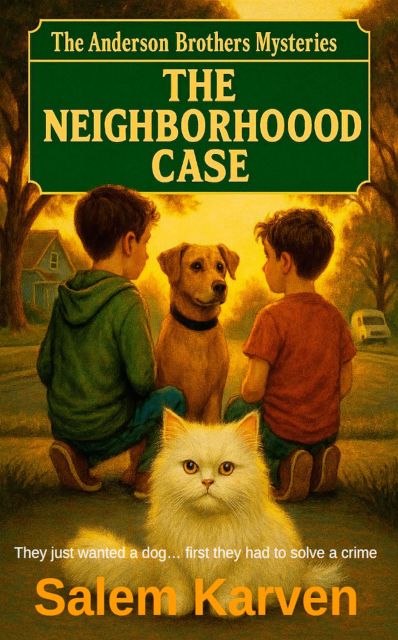
Hi Russell, I want to share something with you today that surprised even me when I first read it. Researchers studying reading habits in children aged 8 to 14 found that young readers who regularly read mystery fiction showed measurably stronger critical thinking skills, higher vocabulary retention, and significantly better performance in problem solving tasks than children who read other genres at the same rate. In other words — mystery books do not just entertain children. They train their brains. Here is exactly what happens inside a child's mind when they read a great mystery series — and why it matters far beyond the last page. ---------------------------------------------------------------------------------------------------------- 5 ways mystery books make kids smarter.1. They develop logical reasoning. Every mystery presents a child with a problem that must be solved using clues, patterns and deduction. Without even realizing it a child reading a mystery is practicing the same logical thinking skills used in mathematics, science and everyday decision making. They learn to ask why, to question assumptions, and to follow evidence rather than guesswork. 2. They build vocabulary faster. Mystery fiction consistently uses richer, more varied language than other children's genres. Words like 'suspicious', 'conspiracy', 'evidence', 'motive' and 'alibi' become part of a child's natural vocabulary through repeated exposure in a context that makes their meaning immediately clear. Children do not notice they are learning new words because they are too busy trying to solve the case. 3. They strengthen memory and attention. A good mystery requires a reader to remember details from earlier chapters — a name mentioned in passing, a door that was left open, a conversation that seemed unimportant at the time. Children who read mysteries develop stronger working memory and sharper attention to detail because the story rewards those who pay close attention and gently punishes those who skim. 4. They build emotional intelligence. Mystery fiction asks children to understand why people lie, what motivates deception, and how trust is built and broken. These are sophisticated emotional concepts that most children encounter in real life without ever having a framework to understand them. A great mystery series gives children the emotional vocabulary to make sense of complex human behaviour — in a safe, fictional setting. 5. They turn reluctant readers into passionate ones. This may be the most important benefit of all. Mystery fiction is uniquely compelling for children who struggle to engage with reading because every chapter ends with an unresolved question. The desire to find out what happens next is not a mild preference — it is a genuine compulsion. Parents of reluctant readers consistently report that mystery series are the books that finally make their child choose reading over screens. --------------------------------------------------------------------------------------------------------- It is important to me that the Anderson Brothers Mysteries has every one of those five benefits built into every single book. Daniel and John Anderson solve real mysteries using genuine logic, real clues and sharp observation. The cases they face are complex enough to challenge a young reader's thinking without ever being too difficult to follow. The language is rich but accessible. The details matter — and children who pay attention are rewarded for it. And every chapter ends with a reason to keep reading. The best way to experience this for yourself is to hand your child the prequel — completely free — and watch what happens. If they love it — and the science says they will — the complete five-book Anderson Brothers Mysteries series is waiting for them on Amazon. With warm regards, Salem KarvenAuthor — Anderson Brothers Mysteries
|